
Trace Kentucky Former Property Owners
How far a former-owner search can reach depends on the county. Its record series matter, and so does whether a book was indexed or scanned. KDLA's statewide guide describes deed holdings from roughly 1781 through 2018. That range is a collection horizon. It is not a continuous online run for every county. The current county clerk index anchors any modern chain. Older material may sit with the clerk. It may sit with KDLA. Or it may sit with another repository named in the county inventory.
| Source | Time span | Where to look | Use in the chain |
|---|---|---|---|
| County deed index and images | County-specific start and image dates | County clerk portal or office | Recorded transfers and source-of-title references |
| Deed books and microfilm | KDLA holdings span roughly 1781 to 2018; local runs vary | Clerk or KDLA inventory/request | Older conveyances beyond a portal's image range |
| Tax lists and assessment books | Collection-level holdings from roughly the 1780s into the 2000s | County repository or KDLA | Possible ownership clues when a deed chain has a gap |
| Land patents and surveys | Early land-grant records; search fields vary by series | Kentucky Secretary of State Land Office | Original grant, warrant, survey, and watercourse context |
Use the record that fits the era, then verify each clue in the official document. A tax list can place a name in time. It cannot replace the deed that conveyed the land. A patent explains the first grant. Later private transfers stay in county deed books. Historic plats help connect a lot or tract to a description, but they prove nothing about a modern boundary.
Follow Prior Kentucky Owners Backward
Begin with a deed tied to the parcel, not a name that merely looks right. The county clerk records instruments where the property lies. The deed may cite a prior book and page, an instrument number, or a source-of-title name. Most county systems keep separate grantor and grantee indexes. Each prior owner plays a different role from one transfer to the next. Because roles flip, the search moves between both indexes.
- Record the parcel's current legal description, county, and deed reference. Keep the situs address as a locator, since addresses can change or fail to match older land descriptions.
- Open the acquisition deed and copy the grantor, grantee, date recorded, legal description, and source-of-title reference as written.
- Search the earlier grantor in the grantor index, then locate that party's acquisition as grantee. Check the image or volume when available.
- Repeat until the description changes, a parent county appears, or the index and image series end. Write down each gap and its likely custodian.
- Grantor
- The party shown as conveying an interest.
- Grantee
- The party named as receiving the interest.
- Chain of title
- The linked sequence of recorded transfers for the same land.
- Legal description
- The deed's description of the property, which may use a lot, acreage, boundary calls, or adjoining land rather than a street address.
Spelling and roles vary across the indexes. Check initials, spouse names, executors, administrators, trustees, commissioners, corporate names, and "heirs" references when the record points that way. Keep notes on the date, county, index side, query, result, and open-image status. The Kentucky deed-records page explains the clerk's index labels and copy routes.
Note: Keep a chain worksheet with every instrument number, recorded date, grantor, grantee, and source-of-title reference.
A Kentucky Deed's Source Clue
INSIDER TIP: read the source-of-title paragraph before leaving a deed image. It often names the prior grantor. It may give a book, page, or instrument reference that saves a broad name search. Treat that reference as a lead. Open the earlier record and compare its legal description. The name alone may fit another parcel.
When a deed cites an older county office or a record that does not appear online, keep the exact reference. Ask the clerk where that series is held. A clean chain comes from checking the same land at each step. Collecting similar names builds nothing, and in Kentucky the portal ranges and book formats vary by county.
Kentucky Parent Counties Explain Missing Deeds
A historic parcel may cross more than one county's records as boundaries shifted. A deed may sit in a parent county's books first. That is a repository shift, not a missing instrument. The Secretary of State's county-formation archive shows when each county was formed. The clerk and KDLA inventory then show where the older deed series belongs.
STORY: Kentucky's land trail can run from a state patent to a county court order. From there it moves into a county deed book. Later it passes into a modern PVA and GIS layer. The layers grew at different times. A present-day parcel number may not appear in the oldest book. A street name may not have existed at the first deed. Titles and boundaries answer to their own era.
For an old chain, note the modern county. Note the county existing on the deed date. Record the legal description and the repository searched. The Kentucky county formations archive gives the legal history. It is not a parcel map. It offers no title finding. Use it to pick the next clerk or archive to search.
Tax Lists Bridge Older Kentucky Deeds
KDLA's land-record guide points out a pattern worth knowing. Deeds from about 1890 forward commonly cite a prior recording. Earlier ones may not, which can make a deed trail hard to join. Tax records can bridge the gap. KDLA describes county tax lists running from roughly the 1780s into the 2000s. Wills run from the 1780s into the early 2000s. Treat those as broad collection ranges. No county is promised every year.
A tax list may show a name tied to taxable land in a given year. It is not a substitute for a deed or probate record. A will can identify heirs or an estate context. The county clerk's deed records then show how the transfer entered the land-record chain. Search names and land descriptions from each source. Then return to the clerk's deed books to connect them.
Historic plat and survey records can also clarify the tract as first described. A plat may name lots, roads, and easements. A survey or metes-and-bounds call may lean on streams, roads, or adjoining owners. Keep those clues apart from modern GIS outlines until a record connects them.
Note: Match each historical county boundary to the relevant year before concluding that a clerk's index is incomplete.
Kentucky Patent Records Preserve Land History
For early ownership, a state land patent, warrant, or survey can explain the first grant or the tract's original calls. It is distinct from a later private conveyance: after the grant, deeds still belong in the county clerk's land records. The Secretary of State Land Office index covers patents, warrants, surveys, grants, county court orders, wills, county formation, and the Jackson Purchase.
The Tellico Land Office search offers fields for name, patent or certificate number, county, survey year, grant year, warrant number, and watercourse or location. For a tract with an old name, watercourse or warrant details may work better than a modern address. Save the patent, survey, and county-court references as a group, then continue forward into county deeds.
The Tellico search screen shown below has controls for an early-land query, but a patent description may use calls that do not map neatly to a present street address.
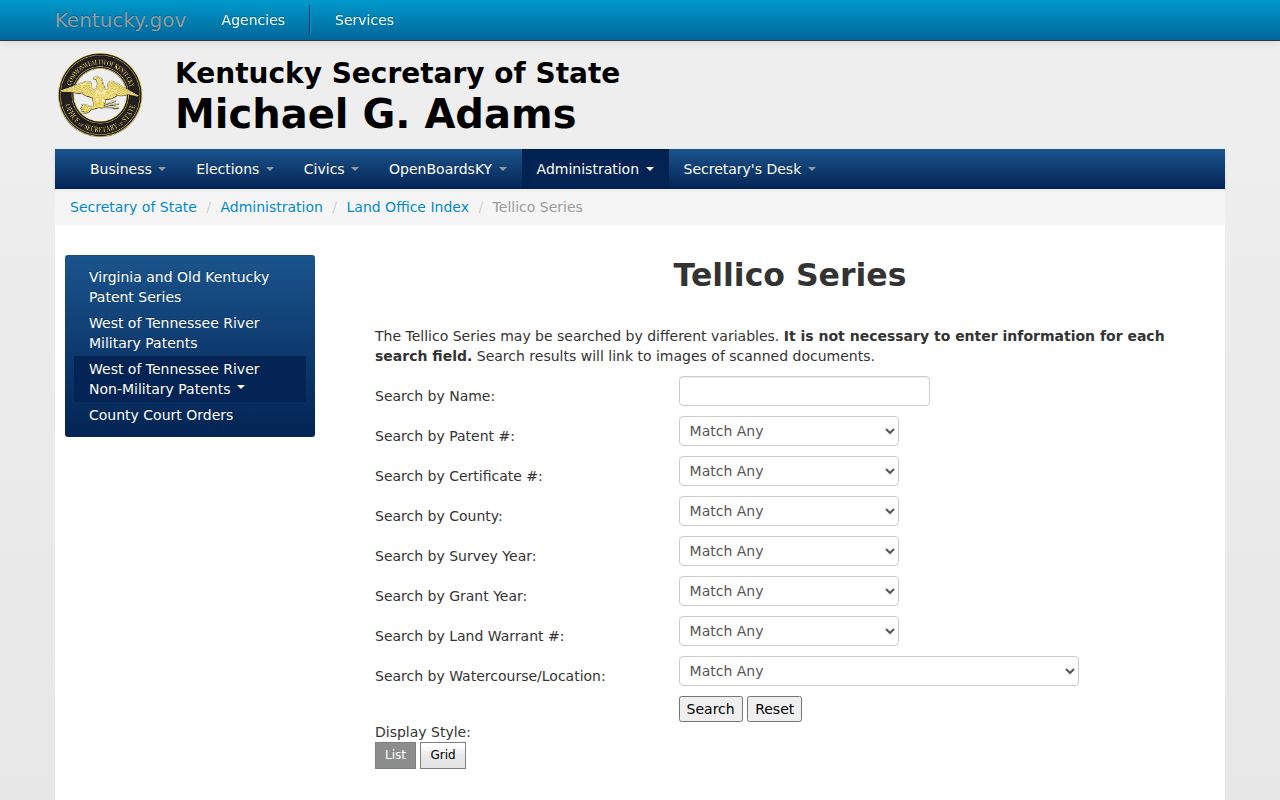
Start with the patent, then follow the county deed chain forward through later transfers.
KDLA Routes Kentucky Deed Books and Microfilm
Older deed books do not always stay in the county. Some volumes have moved away. The Kentucky Department for Libraries and Archives serves as the statewide route to them. A strong request names the county, the record series, the parties, an approximate date, the prior county if known. It should also cite any book and page or instrument number. More detail means a faster answer. KDLA charges a nonrefundable research fee, $20 for Kentucky residents and $25 for out-of-state requesters. Scan, copy, postage, and tax costs are added as they apply. Expect four to six weeks. The archive is simply not a same-day deed search.
The KDLA request page lays out the records request path in full. Many researchers prefer the Frankfort research room itself. It is open Monday through Thursday from 9:00 a.m. to 3:30 p.m., with appointments recommended. Read the KDLA visiting information before making the trip. The KDLA visit page posts the access details. The staff there can reach a book or film that no county website serves. Local libraries, historical societies, and university collections help too. Their maps and finding aids can point the way. Confirm every transfer against the official deed records.
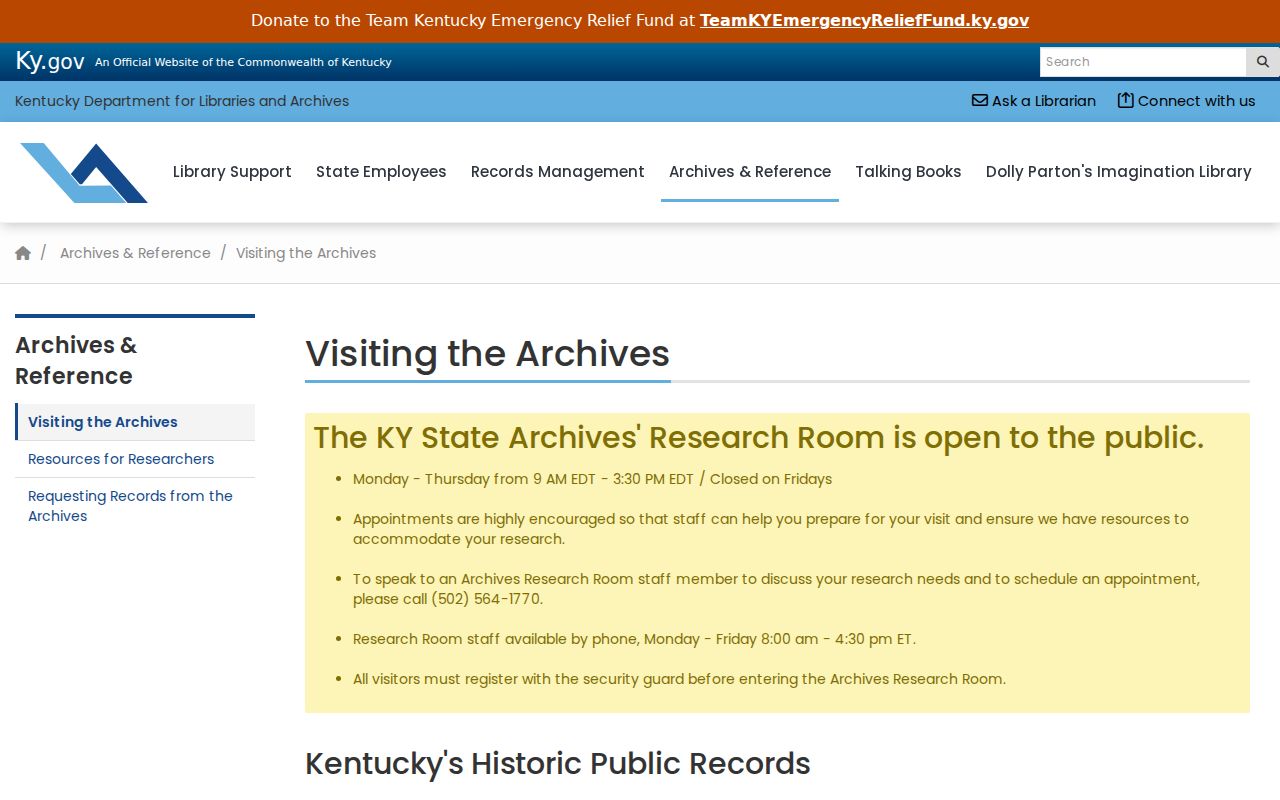
Check current access instructions and the county inventory before planning an in-person review.
How Far Back Kentucky Ownership Records Reach
No official statewide table lists each county's oldest online grantor or grantee image. eCCLIX participation is county-specific. An index may also reach farther back than its scanned documents. The eCCLIX availability page lets a researcher check the listed county series. The local clerk can confirm offline books and other vendor systems. If a result stops, report the last year and source actually searched. Do not call it a statewide cutoff.
MYTH: a missing image or search hit does not prove a deed never existed. It may be unscanned. It may be held in an older volume. It may be indexed under a different spelling. Or it may have been recorded when the land sat in a parent county. State the searched county, index side, names, dates, and image status. Then follow the clerk or KDLA route.
Former-owner research serves house history, land due diligence, and a parcel's recorded past. Is a deed book not online? Contact the county clerk by phone or written request. Include the book, page, county, names, and date range. The Kentucky local-official directory helps locate the office. A Kentucky resident may file a written Open Records Act request for nonexempt records. A qualifying business or real-property owner may file one too. Submission can be by hand, mail, fax, or email. Follow the clerk's specialized copy process first. Keep personal details to what verifies the record. Never use an ownership chain to target or harass a living person.
Respect the limits of the record. A chain assembled from public deeds is a research trail, not a title opinion or a reason to contact people. Verify important ownership questions with the clerk's record and a title professional.
Note: State the earliest verified index date and separately describe any older book or archive search.