
Compare Kentucky Property Value Types
Numbers from a Kentucky value search can look identical while describing different things. The PVA's assessment is an administrative figure. It exists to feed the property-tax roll. Fair cash value is the standard Kentucky applies to ordinary real property, and agricultural-use value works as a specific exception to that rule. A deed tells another story. Its consideration amount documents a single transfer, not a new assessment or a guaranteed market price.
| Value type | What it means | Where to look |
|---|---|---|
| Assessed value | The PVA's value on the assessment roll for the stated year | County PVA record |
| Fair cash value | The statutory valuation standard for ordinary real property | PVA assessment and DOR guidance |
| Agricultural-use value | A different assessment basis for qualifying agricultural land | PVA record and farm-property rules |
| Sale or consideration price | The value stated for a recorded conveyance; context affects how it reads | Deed image and, sometimes, PVA sales history |
| Land and improvement values | Separate portions of a PVA's total value, where listed | County PVA parcel card |
Keep the label attached to every figure. A number without its label means little. Kentucky sets the ordinary assessment level at 100 percent of fair cash value, though the figure is still not a licensed appraisal or a promise about a sale. An exemption can push taxable value below assessed value. For the tax-bill and exemption details, turn to the Kentucky property tax records page.
Find a Kentucky PVA Value Record
Each of Kentucky's 120 counties has a local Property Valuation Administrator. There is no statewide owner-name or address search. Identify the county first. The Department of Revenue local-official directory then routes you to the right PVA contact. A parcel ID links the PVA record to a GIS map and a deed. Its format varies by county.
- Confirm the county from the property's location, then open that county PVA's official search page.
- Search by address or parcel ID if the public form offers those modes. Check punctuation and partial-number rules shown by that county.
- Read the value label, assessment year, land and improvement fields, and any exemption or agricultural classification actually displayed.
- For a sale comparison, find the deed reference or recorded consideration and note the deed date separately from the assessment year.
- Assessed value
- The value entered on the PVA assessment roll for the stated year.
- Fair cash value
- The state's ordinary real-property assessment standard, subject to recognized exceptions.
- Agricultural-use value
- A separate valuation basis that may apply to qualifying agricultural land.
- Consideration
- The value stated in a conveyance document; it may need context before comparison.
Need to work from an address to a parcel? The Kentucky property search steps lay out that route in detail. It should end at the county record itself, never a statewide estimate.
Note: Keep source, field label, tax year, and lookup date attached to each figure so unrelated values are not combined.
Kentucky Assessments Use a Fair Cash Standard
Kentucky's KRS 132.191 fixes the general assessment level at 100 percent of fair cash value. That sounds simple. It is not an appraisal. The Department of Revenue explains that assessors weigh sales-comparison, cost, and income approaches as each property suits. A PVA assessment is mass valuation. It is not a one-property appraisal prepared for a buyer or seller.
A farm parcel that meets the applicable rules may be assessed at agricultural-use value instead of ordinary market value. Exemptions can widen the gap. Taxable value can fall below assessed value. Keep acreage, land value, improvement value, total assessed value, and taxable value in separate fields when a county card shows them. The DOR residential, farm, and commercial property guidance covers the state framework. The local PVA record holds the parcel-level figure.
Two parcels with similar sale prices can still show different assessment details, because land use, improvements, or exemption status differ. Compare like fields and years.
January 1 Shapes Kentucky Value Records
Kentucky runs its assessments on an annual cycle. Under KRS 132.690, every parcel must be revalued each year, with a physical examination at least once every four years. That cadence explains a common mismatch in property records. An assessment and a recent sale rarely land on the same date. A deed recorded after the roll date can surface a transfer weeks before the PVA record catches up. Where a property sold during the prior year and no other change applies, DOR says the deed value may feed the following January 1 roll.
The Kentucky property tax calendar spells out that statewide sequence. Use it to date a value field, not to guess a sale price or decode a tax bill. Portal refresh habits vary by county. No statewide service standard dictates how quickly a PVA must update online fields after a deed posts.
For timing context, the DOR calendar lays out the year's framework at a glance. Before reading meaning into any change, line up four dates: the calendar year, the PVA roll year, the deed recording date, and the date the online record was retrieved. Small gaps between those dates are normal.
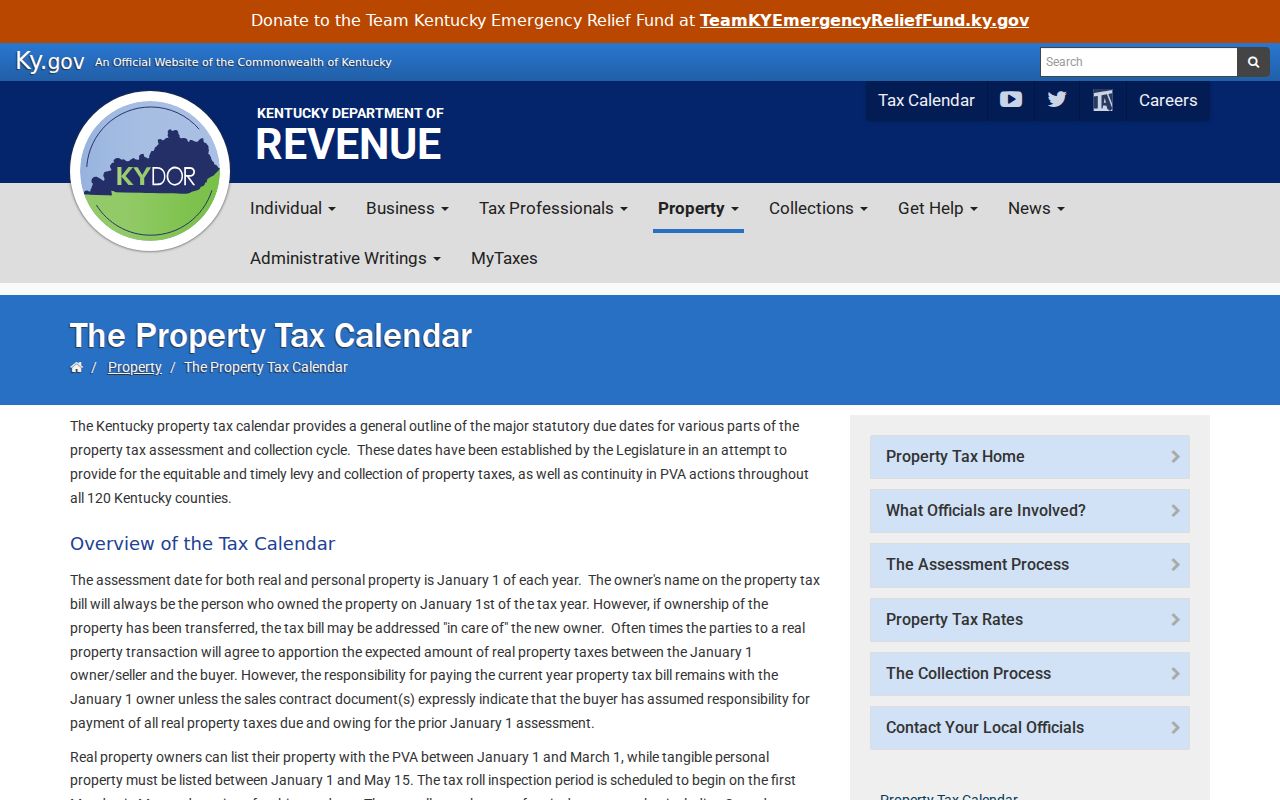
Dates frame when a value was set. For a specific parcel's figure, the county PVA remains the source.
Kentucky Assessed Value Is Not Sale Price
MYTH: a deed price and an assessed value are different numbers. The first reflects one recorded transfer. The second reflects the assessor's figure for a given year. Neither is a live market quote.
Deed records state the consideration tied to a single transaction. That figure can be nominal, exempt, partial, or set between related parties. It is not always an open-market signal. Read the date, the parties, and the legal description. Check these along with the number before trusting it.
The PVA tax roll answers a separate question. What value did the assessor place on this parcel for that assessment year? A portal's sales-history field, where a county offers one, is only a reference. Confirm any material figure against the clerk's deed image. Never inflate one transfer into an appraisal or a trend.
Label every figure in a Kentucky property value comparison. Note the source, field name, year or recording date, and parcel number. That trail keeps each measure distinct and the result honest.
Note: Match the parcel and deed date before comparing recorded consideration with an assessment roll or a modeled market estimate.
Kentucky Deeds Carry Sale Context
Start with the deed itself. A recorded deed verifies the transfer document and its stated consideration. KRS 382.135 covers full consideration and value statements. It also covers grantor and grantee names and mailing details. Many PVA cards show a last-sale field or deed reference. Treat those as pointers. Follow the reference to the underlying instrument. Do not treat the property card as the original source.
Consideration and market value diverge for reasons the transfer itself reveals. A family transfer may not be an arm's-length sale. An estate distribution or a partial interest may not be either. The deed's legal description also confirms the sale's parcel. It must match the same parcel as the PVA entry.
For a sound Kentucky property value comparison, match the parcel first. Then read the deed date and consideration. Keep the PVA assessment year separate. The official index may list a document but show no image. In that case, contact the county clerk for the copy route.
Kentucky Value Searches Differ by County
Portal fields and access rules stay local in Kentucky. Jefferson County PVA is one example, not a statewide template. Its public page offers Address and Parcel ID modes. Owner, Legal, and Sales Search require a paid account. Other counties use different vendors and policies. Check the portal itself before assuming any option or fee applies statewide.
| Inspected Jefferson PVA mode | Search field | Access and format note |
|---|---|---|
| Address | Tab and optional text field | Full address, street-only, or number range; punctuation, city, state, and ZIP are not needed |
| Parcel ID | Tab and optional text field | Spaces and dashes are not needed; a partial ID may search a range |
| Owner | Tab and text field | Paid account required on the inspected Jefferson page |
| Legal | Tab and text field | Paid account required on the inspected Jefferson page |
| Sales Search | Tab and text/filter | Paid account required on the inspected Jefferson page |
| Search and Reset | Form controls | Submit and clear the selected search mode |
INSIDER TIP: a login gate in one county says nothing about the rest. Use the DOR directory to reach that county's PVA office. Ask whether counter access or another official route exists. Some public records still require a local copy request.
Where online access falls short, in-person inspection at the PVA office is generally open. Call or write the local office for the current method. A Kentucky resident, qualifying resident business, or real-property owner may file a Kentucky Open Records Act request for nonexempt records. Submit it by hand, mail, fax, or email. Follow any specialized PVA copy procedure first.
The Jefferson County PVA search page documents that example's fields and access notes. Its paid modes do not describe the rest of Kentucky.
Kentucky PVA Value Fields Vary
No sample parcel card fits every Kentucky county. The state has no single PVA portal, and the Jefferson search page requires an account for some result modes. Treat the fields below as a checklist for any county card. None is guaranteed on every PVA record. Read only the labels your local record actually displays.
- Value year: the assessment year or roll date tied to the displayed figure.
- Land and improvement: separate land and building values when listed, plus the total assessed value.
- Taxable value and exemption: a separate taxable figure or exemption flag may explain a difference from assessed value.
- Sale history: last sale date or sale price may appear, but it is county-variable and should be matched to a deed.
- Deed reference: book/page or instrument number can help locate the recorded source of a transfer.
Some county cards add property characteristics, a sketch, a map, or value history. These vary by PVA. None replaces the deed image when verifying a sale, or a market appraisal when estimating a sale price.
Note: Use only fields shown by the local card, and ask the county PVA about labels or years that are unclear.
What Kentucky Property Value Cannot Prove
An assessed value is not a survey, a title finding, or a sale appraisal. It cannot fix a boundary, prove the owner of record, or predict a buyer's offer. Its meaning depends on the field label, the assessment year, and any special valuation basis or exemption the county PVA reports.
Assessment versus price. Kentucky's assessed value is a tax-roll figure under state assessment rules. For a current sale valuation, use a licensed appraiser and relevant market evidence, not the PVA number alone.
Read the assessment on the PVA record. Read the recorded transfer on the county clerk's deed. Only compare the figures after matching the county, the parcel, and the dates.