
What Kentucky Property Tax Records Hold
No single statewide account search covers every Kentucky parcel. The county Property Valuation Administrator, the PVA, keeps the assessment roll. The sheriff usually bills and collects the current year's property taxes. Delinquent-tax certificates and related sale material land with the county clerk. The Department of Revenue sets statewide guidance and links to local officials. It does not hold every parcel card or bill. You can cross-check these records against each other, though one never substitutes for another.
| Field | What It Shows | Where |
|---|---|---|
| Parcel and assessment year | The county account key and the roll year tied to the assessment. | Local PVA |
| Owner and mailing address | The name shown on the tax roll and where notices are sent; the mailing address may differ from the property's location. | Local PVA |
| Assessed and taxable value | The PVA's value fields, with any applicable exemption reflected separately or in taxable value. | Local PVA |
| Bill and payment status | The current amount due, installments or receipts where offered, and whether payment is posted. | County sheriff or bill service |
| Delinquency or sale record | A certificate, notice, purchaser filing, redemption, payment, assignment, or release at its recorded stage. | Sheriff, county clerk, DOR guidance |
A PVA number belongs to the assessment roll, nothing else. The bill is its own account. It tracks charges, credits, payments, and any balance for a period. A sale price lives in the deed or transfer record. It can differ from both figures. For how assessed value compares with a sale price, the Kentucky property value lookup treats them as separate measures. Assessment facts come from the PVA. Payment facts come from the sheriff or the county bill service.
Kentucky Property Tax Roll Timing
Kentucky PVA offices keep an annual assessment roll. State law calls for revaluation every year. A physical inspection must happen at least once every four years. The statewide rule sits in KRS 132.690. The Department of Revenue explains the PVA assessment process. A shared rule does not mean every county posts online card updates on the same day. Counties also differ in portal fields.
January 1 is the anchor to use when weighing a recent transfer against the roll. DOR notes that a deed value may be considered for the following January 1 roll. That applies when the purchase happened in the prior year and no other change controls. That is not a same-day ownership refresh. Keep the recording date, the assessment year, and the bill period beside every number. That habit keeps a change of owner from being confused with a change in value.
Note: Read the assessment date, roll year, and bill period together before treating a change in owner as a value change.
Kentucky Assessment vs. Property Tax Bill
An assessment and a tax bill answer different questions. The PVA sets the assessed value for tax administration, while the local collection system issues the bill itself as a charge statement. Kentucky law generally requires fair cash value for assessments, though qualifying agricultural land may be valued at agricultural-use value and exemptions can shrink taxable value. Bills often list the taxing units involved. Local charges tied to the account may appear too. The statewide DOR framework does not impose a single bill amount on every parcel.
- Assessed value
- The PVA's value on the roll. DOR describes sales-comparison, cost, and income approaches; a value field is not a sale offer.
- Market or fair-cash value
- The value standard used for ordinary assessment; qualifying agricultural land may use agricultural-use value, while exemptions reduce taxable value.
- Mill rate or levy
- A local charge applied through the tax bill. Check the bill and local taxing-unit information for the parcel's actual figures.
- Homestead exemption
- An exemption category shown in PVA tax information. Use the current DOR guidance and local PVA to confirm qualification and filing steps.
- Tax lien or certificate of delinquency
- A record associated with unpaid property-tax collection. A certificate of delinquency is not, by itself, a deed conveying marketable title.
A bill balance is not the assessed value. A sale price is not the tax base either. If the figures seem out of step, compare their dates and ask the office that issued each record.
Looking Up a Kentucky Property Tax Bill
Start in the county where the land sits. Copy the PVA parcel ID or Map ID if one is listed, since that key ties a tax bill to the same land record better than a street address can. County sheriff sites and payment vendors vary, so the DOR local-official directory is the quickest route to the PVA, sheriff, and county clerk when the right billing office is unclear.
- Find the county PVA or sheriff through the DOR directory. Keep the county name with the address because Kentucky has a separate local route for each county.
- Use the county bill service's available fields, such as owner name, property address, tax year, bill number, or parcel/Map ID.
- Read the bill year, location, account balance, and payment status together. Do not substitute the assessment field for a paid or unpaid balance.
- If no public bill search is offered, ask the sheriff's tax office for the current account or payment record, using the parcel and year to narrow the request.
Boone County's e-pay screen is one local bill search, not a Kentucky-wide system. It shows these fields and result details:
| Visible item | What the Boone example exposes | Scope |
|---|---|---|
| Search fields | County, Bill Number, Year, Owner Name, Map ID, and Property Address, with Submit and Reset controls. | Boone County e-pay capture |
| Result columns | Bill Number, Map ID, Year, Owner, Location Address, and Account Balance. | Up to 250 rows in the inspected screen |
The Boone County e-pay search shows how one county joins a bill number to a map ID and location. It does not establish fields, access, or payment options elsewhere. Verify the live county service before relying on a result, and keep a bill copy or receipt with its year.
- Parcel or Map ID
- The county's account key for the property. Keep punctuation and leading characters as the PVA presents them.
- Tax year
- The bill period. A search result for another year is not proof of the current balance.
- Account balance
- The amount shown by the bill service at the time checked; confirm a payment or payoff with the collecting office.
Kentucky Tax Exemptions on the PVA Roll
A PVA card can flag exemptions or split assessed and taxable values into separate fields. The Department of Revenue runs a statewide property-tax hub. It covers assessment rules, exemptions, rates, and local contacts. The local PVA, though, keeps the parcel's actual record and walks owners through the paperwork. Begin with the Kentucky property-tax hub. Still, an exemption listed in one county's portal proves nothing about another county. It never proves a specific owner of record qualifies.
Raise a value question with your evidence in hand. Keep the parcel number and the roll year. Also keep any exemption or classification labels from the PVA card. Ask the local office which form or proof applies before you send sensitive documents. The DOR assessment page lays out the fair-cash and agricultural-use framework in general terms. The PVA shows how those rules land on your account. A bill may include a reduction or credit. But the bill never settles the underlying assessment decision.
Note: A field label alone does not confirm eligibility; ask the local PVA for the current rule and filing route.
Kentucky Tax-Sale Certificates Are Not Deeds
An unpaid property tax bill in Kentucky leaves a paper trail. It runs from the sheriff's tax account. It ends in a notice or certificate filed with the county clerk. Later steps may show payment, redemption, assignment, release, or court action. Each document marks a distinct stage. None of them is a deed on its own.
The Department of Revenue's delinquent property tax page and the Clerk Network link to county sale schedules, forms, and purchaser instructions. Tax sales generally run from mid-July through late October. Each county sets its own date and notice. Confirm with that county before relying on a statewide pattern. Open the Kentucky DOR County Clerk Network to reach its tax-sale and clerk resources.
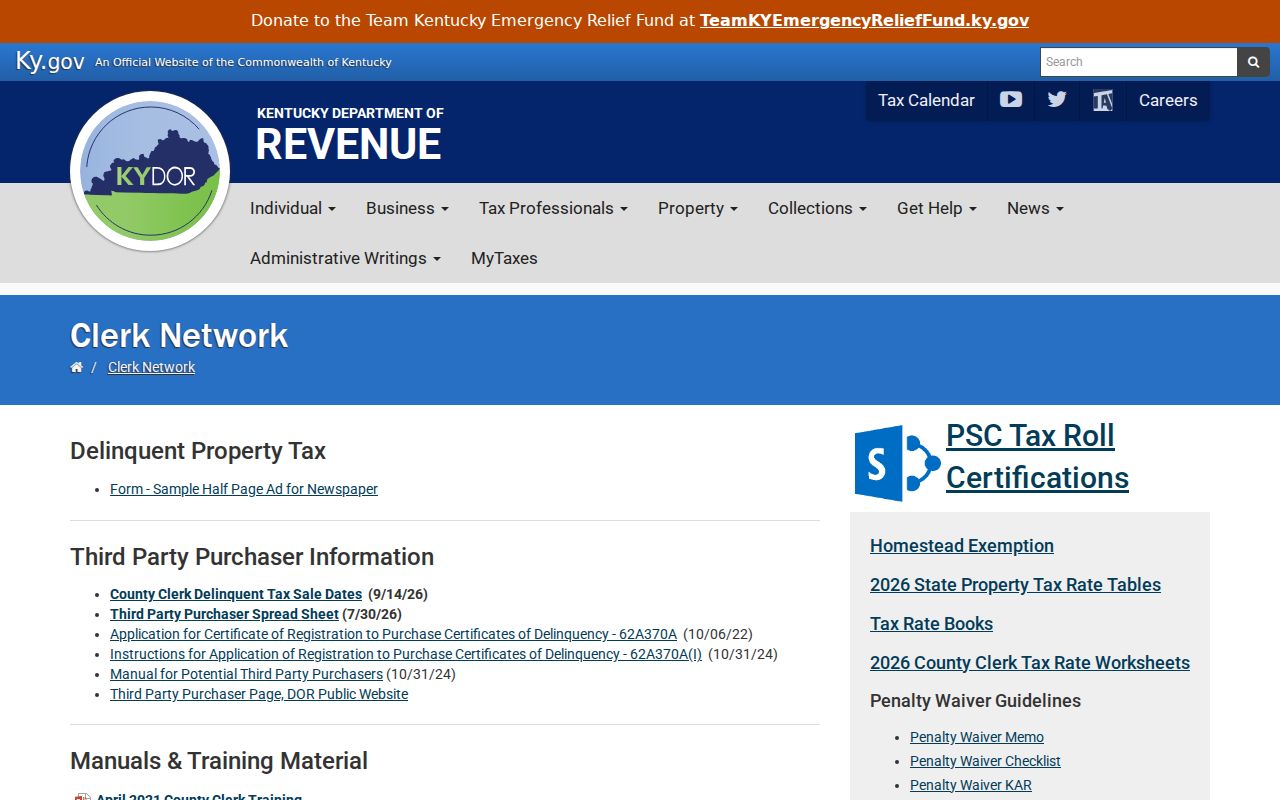
A certificate of delinquency is not a deed. It is not automatic proof of marketable title. Treat the notice, certificate, bill, and any later release as separate steps in the record trail. The DOR third-party purchaser page carries current registration guidance, and fees and thresholds can change, so verify its current instructions before quoting them.
Appealing a Kentucky Assessment
A Kentucky owner who disputes an assessment starts locally. The first step is a conference with the local PVA. This follows the county's posted inspection and appeal instructions. The Department of Revenue publishes a statewide property-tax calendar. It lays out assessment, inspection, appeal, billing, and delinquency stages. Pull the current year's dates from the calendar itself. A date lifted from an older season can be wrong. For the parcel, the local PVA is the contact. The county Board of Assessment Appeals is the next recorded review step.
Check the current window. Compare the PVA assessment with the parcel's roll year, property description, exemption fields, and relevant recorded sale information. Ask the PVA for the conference and inspection instructions, then use the current DOR calendar and local board directions for the filing date. The statewide source establishes the annual process, not one permanent deadline that can be reused for every year.
Keep everything in one file. That means the notice, parcel ID, roll year, PVA correspondence, and any evidence you submitted. DOR describes sales-comparison, cost, and income methods. The useful question is which method matches the parcel's record facts. If the case moves beyond local review, rely on the current official instructions rather than assuming an appeal was filed when an inquiry was only made.
Requesting Kentucky Property Tax Records
No single portal covers every county. Start with the office that made the record. The PVA holds assessment and parcel history, while the sheriff handles the current bill and any payment receipt. The county clerk keeps certificates and recorded tax-sale instruments. The DOR local officials page routes you to local contact details, and a counter visit or phone call can identify the correct record series; for a copy, state the county, parcel ID, tax year, record type, and whether you need inspection or a certified copy.
Kentucky's open-records law gives residents another route. Under the Kentucky Open Records Act, a request goes to the custodian by hand delivery, mail, fax, or email. The agency generally must respond within five working days. Inspection is free. Paper copies commonly run ten cents per page, subject to the agency's posted policy and other actual costs. Ask first, though, whether a special bill, PVA, or clerk procedure applies.
Older tax assessment books often end up archived. KDLA's records request service is the archive route for those volumes. Transferred county volumes go there too. Its stated research fee is $20 in-state and $25 out-of-state. Copy, scan, and postage charges add on. Estimates run four to six weeks. When nothing turns up online, describe the county, tax series, name or parcel, year range, and prior offices checked so the PVA or archivist can route the request.
Note: Keep each tax year's bill, receipt, assessment, and delinquency record distinct when asking the custodian to verify an account.